
Part of A Teacher’s Experiences series. Today’s Subject: A Detrimental Federal Education Policy.
In 2002, Congress passed the NO CHILD LEFT BEHIND ACT, a federal law enacted under the George W. Bush administration. The previous policy for oversight of elementary and secondary schools was enacted in 1965. This new act was focused on improving the academic achievement of the disadvantaged. A noble goal. It reminded me of the military code of conduct: No Soldier Left Behind… Unfortunately, the results have been a steep deterioration of academic excellence over the last 24 years.
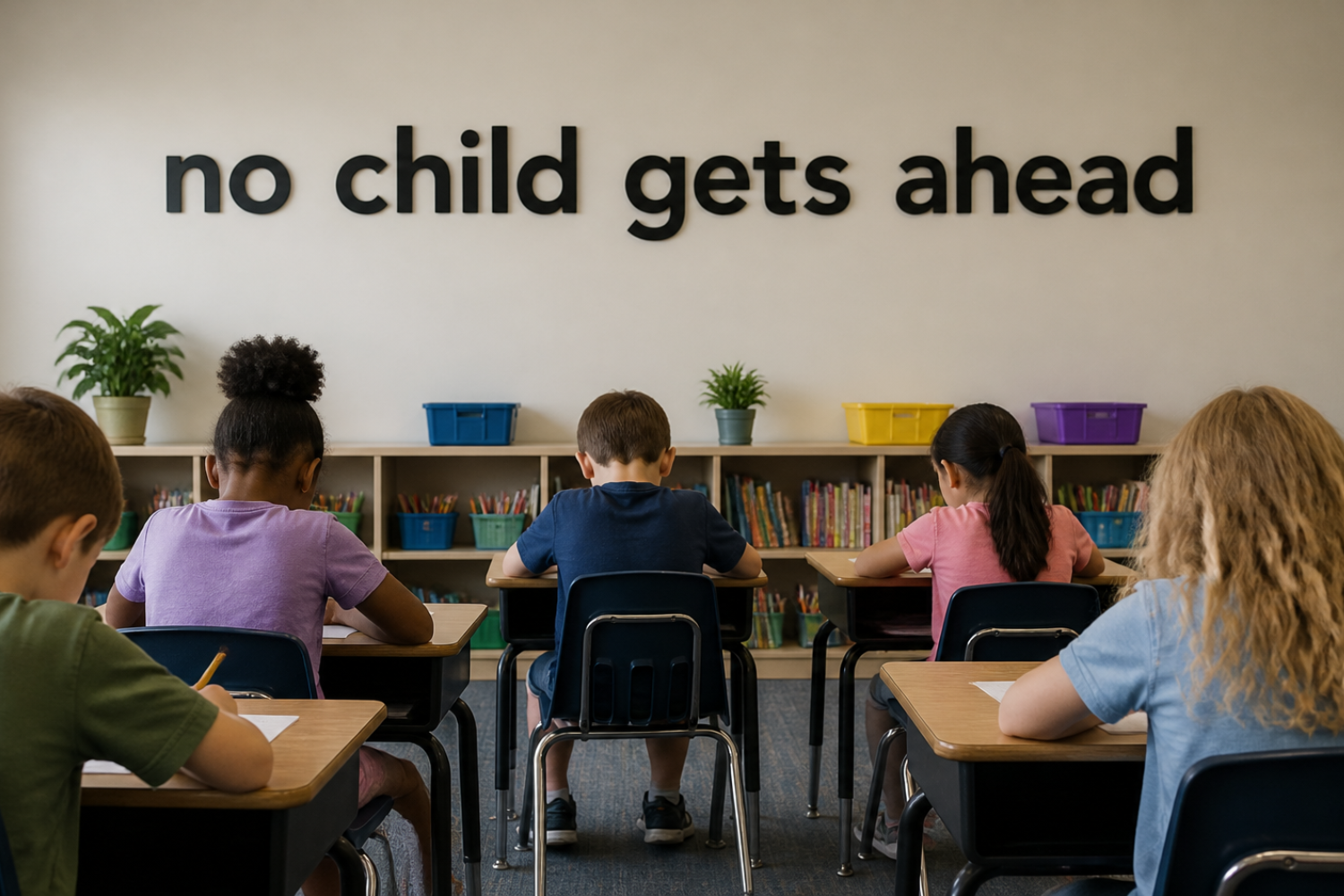
For 24 years I’ve been preaching “No child left behind” means ‘NO CHILD GETS AHEAD!” Our lessons became more broad strokes rather than in-depth investigations. Additionally, teachers were expected to lower grading standards to a grading curve in order to minimize the gaps of the ‘disadvantaged.” I never felt there was a more indecent policy to the integrity of excellence. All students will rise- to varying degrees - to a higher academic standard. We deny excellence when we don’t challenge every student’s potential and make gross assumptions about the viability of the disadvantaged student’s academic success.
Across many California districts as well as many districts across the country, middle school English curriculums were converting to ‘canned’ computer software programs so substitutes would be able to execute a standardized lesson. Teacher absenteeism was a weak argument for this format change and only works if the substitute is trained to navigate the programs. Unfortunately, state education boards want to remove teacher ingenuity in extending curriculum concepts and have lock-step drones provide less interactive opportunities. Having a canned program for student absenteeism does merit the computer program but does not replace robust class discussions and depth of concept projects.
There was a big push in this academic overhaul to push collaborative projects as research indicated this model would be the future of real-world employment. Reasonable enough. It didn’t hurt that group projects also operated as a way to raise poor performing students’ grades which wasn’t missed on my part. Group projects always came down to two groups: the students who ‘had the need to success’ saddled with the ones who loved to ride on the coattails of the worker bees… Afterall, everyone was going to receive the same grade… Hmmm… inequitable effort but same outcome for all? Sounds socialistic.
Well, I believe every student is to be judged on their own merits and had to find a way to assess individual input with collaborative output. My recipe for success for all was having students do their group projects in class—rather than outside class time—in order to monitor engagement. Later, at the end of the group presentation, each student privately graded themselves and their partners’ contributions on a score sheet provided with standards of tasks. Teacher oversight and student evaluations gave credit where credit was due and made all individuals accountable for their own efforts. Variances of individual grades within a group were impacted by the overall academic assessment layered with the input of the group’s self-evaluations. Future employment for up and coming students were around the corner. Learning the value of being an accountable/motivated employee of the future would have a positive lifelong impact.
As our state and national assessment performances plummeted, more administrators were pressing for grading on a curve. By crunching the numbers in this way, an ‘A’ is devalued and ‘F’s’ become ‘D’s’….. Again, a form of deception in my book. A principal can’t order a teacher to change a grade, and I was pressed specifically a few times to reconsider a few grades for low performers. I replied that it’s a disservice to a student to be given a false sense of competency that they haven’t achieved. This practice invalidates the integrity of standardization for everyone! Furthermore, it teaches a student not to work harder, robs them of motivation to improve and deprives them of competitiveness once they are in the rigors of adult employment.
We have raised, unwittingly, an entire generation around a new work ethic of mediocracy; however, this isn’t the ‘ideal’ Americans have stood for since its inception. Americans value exceptionalism like Olympian athletes; the underdog who overcomes low expectations; and the practice that hard work can create higher gains in life. This newest generation coming up has not been exposed to practice these cherished ideals in their own lives to the extent of previous generations and many view these ‘exceptionalisms’ to be outside their personal realities.
Indulge me in an observation over the past 20-30 Halloween seasons. Past generations, up through the eighties, went Trick-or-Treating largely by emulating astronauts, doctors/nurses, police/firefighters, super heroes, ‘Army’ soldiers, inventors, sports heroes, and the like… What have we seen over the last twenty years from the middle/high school-age trick-or-treaters? Cult fiction serial killers, extremely gory mutilated characters, and sexualized, provocative wannabes. Is this a reflection of a nation less influenced by positive role models who exemplified exceptionalism? Notice who comes to your door this year.
In closing, I absolutely encourage MERITOCRACY without apology at any age. If students do not learn—under the parents’ net of support—to accept personal accountability, then we cheat these young students how to learn honest self-reflection, resiliency, and perseverance where they can set higher standards and goals for themselves. Learning the skills of resiliency and perseverance are the best preparation for adult living.
Reminder: These were my teaching experiences and reflect only my conclusions based on what I witnessed with my students’ challenges and successes.