
FPPC Fines Nevada County Over Measure V, Questions Whether the Law Is Tough Enough
SACRAMENTO — Nearly four years after Nevada County voters rejected Measure V, California’s political ethics watchdog has formally concluded that the County used taxpayer money to campaign for the sales-tax measure — and the case is prompting broader questions about whether state law does enough to deter government agencies from using public resources to influence elections.
The California Fair Political Practices Commission on Thursday unanimously approved a $31,500 settlement against Nevada County for seven violations of the Political Reform Act arising from the County’s activities during the 2022 Measure V campaign.
The matter appeared as Item 4 on the FPPC’s August 20 consent calendar. The underlying stipulated decision and order is FPPC Case No. 2023-00162.
The violations included two prohibited campaign-related mass mailings at public expense, two failures to include required advertising disclosures, failure to timely file a semiannual campaign statement, and two failures to timely file 24-hour independent expenditure reports. The seven counts carried a maximum possible administrative penalty of $35,000.
The Commission approved a $31,500 penalty — 90 percent of that maximum.
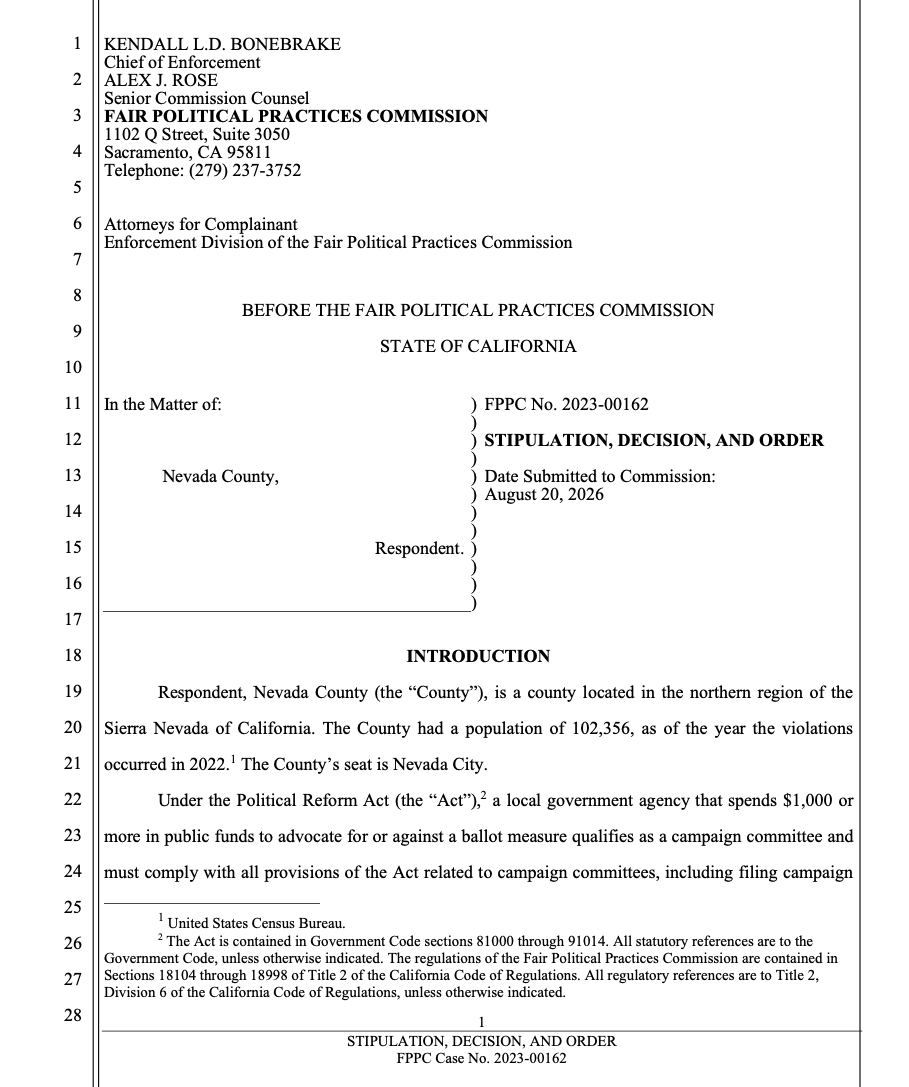
FPPC Stipulation, Decision, and Order (submitted to the commission on August 20, 2026). Click the image to view the entire document.
But Thursday’s meeting went beyond approving a fine.
Commissioners questioned whether penalties ultimately paid with taxpayer money provide sufficient deterrence when government agencies can stand to gain millions of dollars if the ballot measures they promote are successful. The discussion expanded to possible legislative changes, including repayment of improperly spent public funds and potential personal liability for officials involved in approving unlawful campaign communications.
The Nevada County enforcement case could therefore have implications extending well beyond Measure V.
Two Mailers Using Public Funds
Measure V, formally titled the “Wildfire Prevention, Emergency Services and Disaster Readiness Measure,” appeared on the November 8, 2022 ballot. The measure proposed a half-percent countywide sales-tax increase for 10 years. It required a simple majority but failed with 48.41 percent support, receiving 24,144 yes votes.
The FPPC case centered on two mailers Nevada County sent shortly before Election Day. On or around October 7, 2022, the County mailed 33,351 copies of its first communication at a cost of $17,708. The Board of Supervisors funded it through a special appropriation from the County Office of Emergency Services.
A second mailer followed on or around October 26. The County distributed another 33,101 copies at a cost of $16,906, again using a special Office of Emergency Services appropriation.
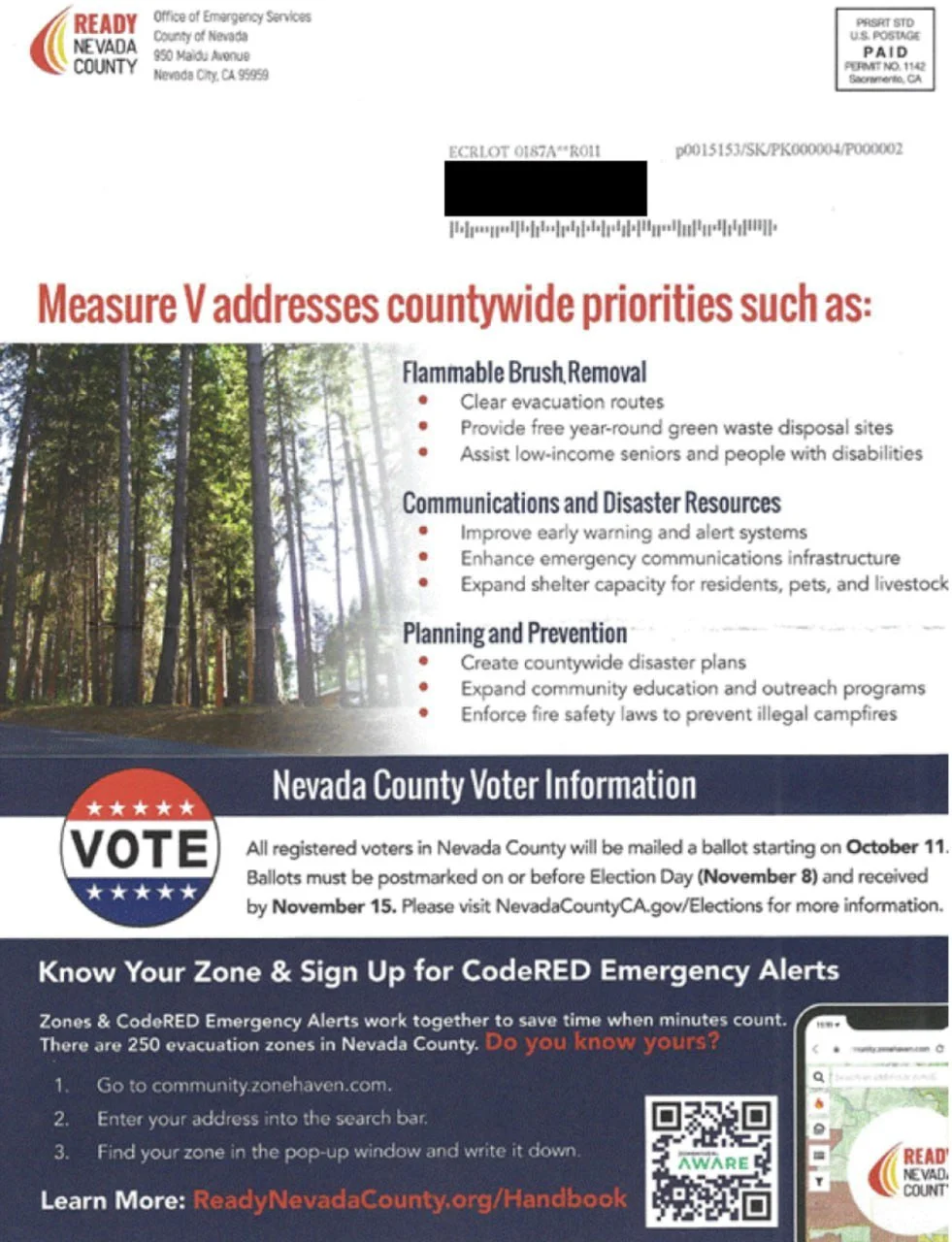
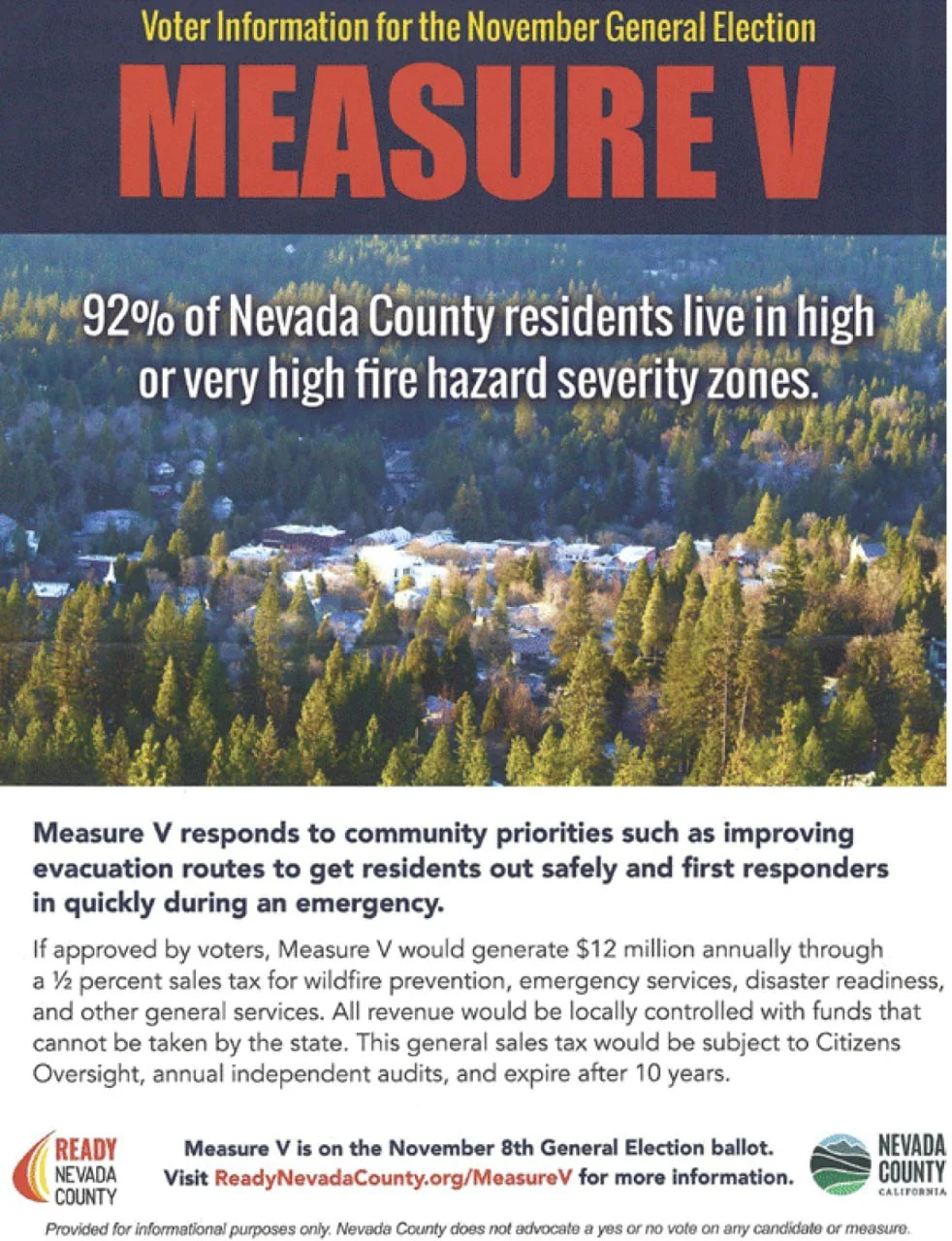
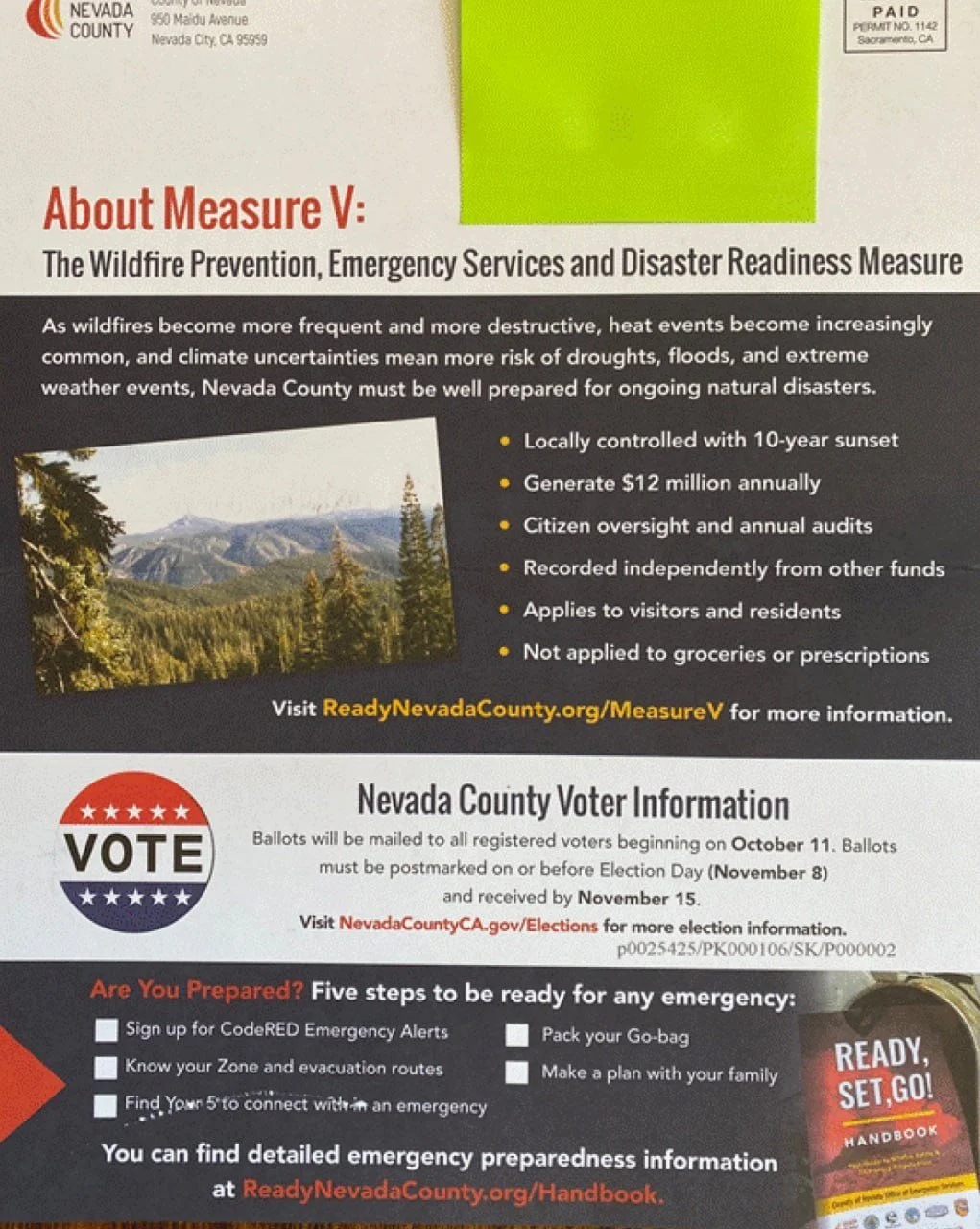
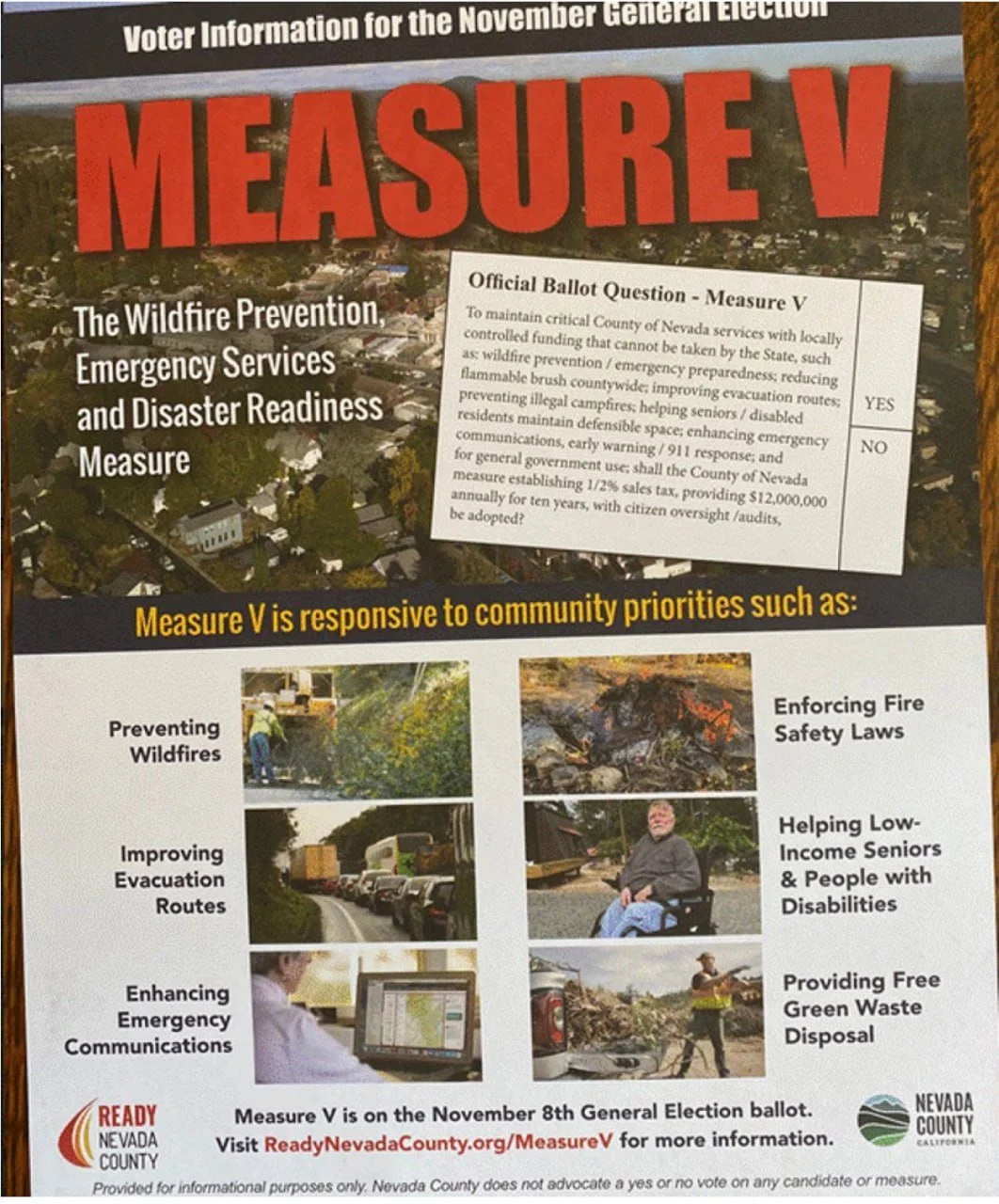
In total, Nevada County distributed 66,402 mailers and spent $34,614 in public funds on communications the FPPC determined constituted campaigning for Measure V.
Government agencies may provide factual information about ballot measures affecting their operations. They may not use public resources to campaign for an electoral outcome.
California law does not require a government communication to explicitly say “vote yes” or “vote no” before it crosses that line. Regulators may consider the communication’s overall style, tenor and timing in determining whether it unambiguously urges a particular result.
The FPPC concluded Nevada County’s mailers did exactly that.
FPPC: Mailers Were “Fundamentally Promotional”
The first mailer said “Measure V responds to community priorities,” listing wildfire prevention, improved evacuation routes, emergency services, disaster readiness, and other “general services.”
Investigators determined the mailer went beyond neutral description: the mailer warned that “wildfires were becoming more frequent and more destructive” and stated that Nevada County “must be well prepared for ongoing natural disasters.”
According to the FPPC, the language created urgency and implied that passage of Measure V was the necessary response.
Investigators also focused on how the proposed tax increase was presented.
According to the stipulation, the half-percent sales-tax increase was buried in the smallest font within a larger block of text while the measure’s purported benefits received greater prominence.
The FPPC concluded that emphasizing the benefits while obscuring the tax increase transformed the communication from objective information into advocacy, calling the presentation “unfair and fundamentally promotional.”
Nevada County included a disclaimer stating that the mailer was provided for informational purposes and that the County did not advocate a yes or no vote.
The FPPC determined the disclaimer did not cure the violation. Based on the communication’s language, timing and presentation, investigators concluded that it nevertheless “unambiguously urges a particular result in the election.”
The second mailer produced the same conclusion.
It prominently stated that “92% of Nevada County residents live in high or very high fire hazard severity zones,” then explained that Measure V would improve evacuation routes so residents could “get out safely” and first responders could enter during emergencies.
FPPC investigators described that and other language as persuasive and value-laden, implying a preferred yes vote.
Formatting also mattered. Measure V’s benefits appeared in prominent, easy-to-read bullet points, while information about the proposed half-percent sales-tax increase appeared within a larger paragraph. The second side did not mention the tax increase or other potential negatives.
Again, investigators concluded that the communication was “unfair and fundamentally promotional.”
Campaign Reporting Requirements Triggered
The FPPC’s findings had another consequence.
Once Nevada County made expenditures determined to constitute independent expenditures, the County became subject to Political Reform Act campaign-reporting requirements. Those reports were not timely filed.
Nevada County should have filed a 24-hour independent expenditure report for the $17,708 October 7 expenditure by October 8 and another for the $16,906 October 26 expenditure by October 27.
The County also failed to timely file an independent expenditure campaign statement reporting the full $34,614 spent during 2022.
The FPPC found that the reporting failures left the public with limited knowledge of the County’s campaign activity, including how much money had been spent, before and after the election.
Why the Penalty Reached 90 Percent of the Maximum
The Commission previously directed its Enforcement Division to pursue penalties at or above 90 percent of the maximum when government agencies engage in campaigning at public expense. Nevada County’s $31,500 settlement follows that policy.
FPPC enforcement staff described the use of public funds for prohibited campaign purposes as carrying a “high degree of public harm.”
Commissioner Elsa Ortiz stated in the meeting, “I have been very concerned about the basic illegality of using taxpayers’ money.”
The stipulation cited the California Supreme Court’s landmark Stanson v. Mott decision and its warning about using the public treasury to influence questions voters are supposed to decide through a free election.
The FPPC stipulation states, “the County supported the passage of a local measure using $34,614 in public funds.”
There were mitigating factors. Nevada County’s name and logo appeared on the communications, the County had no prior record of similar violations, corrective reports were subsequently filed, and the County cooperated with investigators.
Nevertheless, the Commission imposed a penalty near the statutory ceiling.
Commissioners Question the “Cost of Business”
Thursday’s hearing then moved beyond Nevada County.
Commissioners questioned whether the current enforcement system provides sufficient deterrence when penalties against public agencies are themselves paid from public funds.
Commissioner Brandt raised the concern that a penalty could become a “cost of business” if the potential financial return from passage of a tax measure dwarfs the eventual fine. Brandt noted that this type of behavior is becoming more and more accepted, saying that some agencies get a fine and seem to brush it off because they can pay the fine with taxpayer money.
The discussion included possible disgorgement — requiring improperly spent funds to be repaid.
Commissioner Wilson sharpened the issue with a hypothetical: If an agency faced a $25,000 penalty but stood to receive $20 million, it might simply take the risk.
Another commissioner noted that public officials who approve such activity generally do not pay the resulting penalties themselves. Instead, taxpayers—who were the victims of the misuse of public funds—ultimately bear the cost of fines imposed for that misuse.
Commissioners discussed whether personal liability for officials involved in approving unlawful communications could provide greater deterrence.
Silver introduced the idea of violations potentially being prosecuted criminally by local law enforcement.
The discussion raised a fundamental policy question: If taxpayers finance the original unlawful campaign activity and then taxpayers finance the penalty, who is actually being deterred?
FPPC staff explained that the Commission’s current authority has limits. It enforces Political Reform Act requirements involving campaign reporting, disclosures and mass mailings, but does not currently possess direct jurisdiction over the underlying unauthorized expenditure of public funds itself.
Staff indicated that proposals involving disgorgement and individual liability could be considered as possible legislative changes.
Commissioners also discussed the importance of identifying violations quickly enough for voters to learn about them before an election is over — when campaign-finance information is most useful to the electorate.
A Second Measure V Case Remains Open
Thursday’s action resolves the enforcement case against Nevada County. It does not resolve every FPPC matter arising from the Measure V campaign.
A separate companion investigation, FPPC Case No. 2023-00161, remains open and pending. The respondents identified in a written request submitted to the Commission are Cheryl Dell, Douglas Moon, Shirley Moon, Terry McAteer and the “Yes on V” committee.
The distinction between the two cases is important. Case 2023-00162 involved Nevada County and the County-funded Measure V communications. Case 2023-00161 involves Yes on V and its named respondents.
Because Case 2023-00161 remains pending, the FPPC has not announced a final determination that McAteer or any other respondent in that case violated the Political Reform Act. The timing of the unresolved investigation, however, has acquired new significance.
McAteer is currently a candidate for Nevada Irrigation District Division 1 in the November 3 election. He previously served as Nevada County Superintendent of Schools and currently serves on the Nevada County Planning Commission.
In announcing his candidacy, McAteer made transparency a theme of his campaign, stating that NID needs to be a “transparent utility.”
Complainant Requests Resolution Before Election Day
During public comment Thursday, John Young, the sworn complainant in the Measure V matters, asked the FPPC to expedite Case 2023-00161.
The request expressly did not ask commissioners or enforcement staff to presume that McAteer or any other respondent violated the Political Reform Act or to reach a predetermined result. Instead, Young asked the FPPC to “resolve this case while its resolution can still meaningfully inform the electorate.”
The written request argued that either possible outcome should be known before Election Day.
Young stated that if investigators establish violations, voters should have that information before casting their ballots. If the evidence does not support enforcement, McAteer and the other respondents should have the benefit of that determination as well.
“Either result serves the interests of fairness, transparency, due process, and an informed electorate,” the request states.
The request asks the Enforcement Division to take appropriate steps, consistent with Commission procedures and the due-process rights of all respondents, to expedite the investigation and, if reasonably possible, reach a determination sufficiently in advance of the November 3 election.
FPPC Chairman Silver responded to Young, “thank you for your comment. I appreciate you flagging that for us.” The FPPC did not announce Thursday whether it would expedite the investigation.
One Measure V Case Closed. Another Remains Open
Nearly four years after Measure V appeared on the ballot, the FPPC has formally resolved the case against Nevada County.
The County spent $34,614 in taxpayer money on two communications the FPPC determined crossed the line from government information into campaign advocacy. It distributed 66,402 mailers, failed to include required campaign disclosures and failed to timely report the expenditures. The Commission imposed a $31,500 penalty — 90 percent of the maximum available for the seven violations.
But Thursday’s hearing also exposed a larger issue.
When a government agency improperly spends taxpayer money to influence an election, a fine paid from the same public treasury can leave taxpayers effectively paying twice: once for the campaign activity and again for the penalty.
FPPC commissioners are now considering whether California needs stronger consequences, including repayment of improperly spent funds, potential personal liability for responsible officials and faster disclosure of violations while elections are still underway.
For Nevada County, one Measure V investigation has reached its conclusion. Case 2023-00161 has not.
And with a named respondent in that still-pending investigation now seeking election to the Nevada Irrigation District Board, the remaining question has an increasingly important deadline: will Nevada County voters receive the FPPC’s determination before they cast their ballots?