
Grass Valley City Council Candidates Faced Questions on Housing, Wildfire, Spending, and Growth
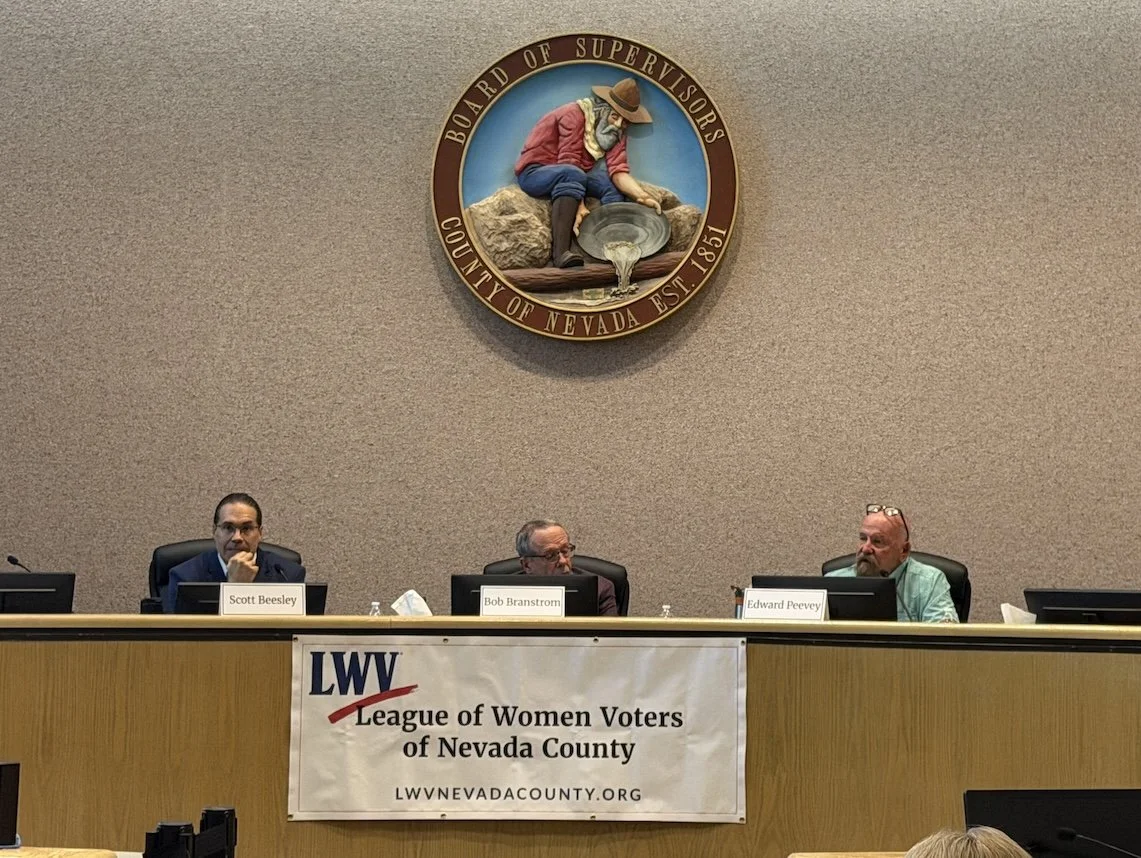
Left to right: Scott Beesley, Bob Branstrom, Edward Peevey
Three candidates seeking two seats on the Grass Valley City Council met September 24 for a candidate forum hosted by the League of Women Voters of Nevada County, moderated by Jennifer Granger. The candidates answered questions about housing, homelessness, wildfire, downtown parking, development and city finances.
Scott Beesley, Bob Branstrom and Edward Peevey participated. Paul Wright will also appear on the November ballot but recently suspended his campaign and endorsed Peevey.
Only 22 people attended the forum in person. Five were affiliated with the League of Women Voters and at least two were members of the press, leaving approximately 15 other attendees. The forum was also livestreamed and available for later viewing.
The three candidates frequently agreed on the problems facing Grass Valley. Their differences became clearer when discussing how the city should address them — and the League of Women Voters left out questions about several significant matters under direct City Council authority, while duplicating other questions.
Housing and Homelessness
Housing affordability emerged immediately. Beesley named affordability and homelessness as his two top concerns. Branstrom chose affordability and wildfire risk, while Peevey identified homelessness and wildfire preparedness.
Branstrom advocated seeking outside funding for subsidized housing and continuing the city's partnership with Habitat for Humanity. Peevey supported smaller homes and apartments in areas where development would not overburden existing infrastructure.
Beesley focused on removing obstacles to construction and said he hopes one of his first appointments as a council member would be with LAFCO to explore areas near town where development could occur outside the historic district.
Their approaches to homelessness differed more noticeably. Peevey emphasized that the issue of homelessness has related issues of mental health, substance abuse, and crime. He encouraged coordination among behavioral health providers, courts and nonprofits. Branstrom advocated compassion and discussed safe parking for people living in vehicles, including developing a specific area where all homeless individuals living in their cars could park and live. Beesley argued that youth, people experiencing temporary setbacks, and chronically homeless individuals require different approaches.
One question that did not follow the housing discussion was how the city would pay for infrastructure needed to accommodate additional development. With all three candidates supporting additional housing, voters were not asked how they would determine whether existing water, sewer, roads and public-safety services can support that growth — or who should pay when they cannot.
Disaster Planning Raises Questions About COAD
One of the night's clearest disagreements involved whether Grass Valley should financially support the developing Community Organizations Active in Disaster, or COAD.
Branstrom said he supported the concept but wanted more information before committing city funds, suggesting that a small amount of seed funding might be appropriate. Peevey opposed city funding for another new nonprofit organization, pointing instead to existing groups already working on wildfire preparedness and risk reduction.
Beesley strongly supported COAD, arguing that it would fill a different role by coordinating organizations that currently operate separately during disasters. He said churches, nonprofits and neighborhood groups may each have information about residents who need evacuation assistance and that consolidating such information could help emergency responders.
Beesley is directly involved with the effort he was advocating for city funding. He serves on the COAD steering committee and is also a board member and Investment Committee chair for the Community Foundation of Nevada County, which is leading development of COAD and seeking funding to launch and sustain it. Beesley disclosed his COAD steering committee role during his closing remarks at the forum.
Those connections are relevant because the question specifically asked whether the City of Grass Valley should provide financial support to COAD. They do not, by themselves, establish a legal conflict of interest. If Beesley is elected and a proposal for city funding of COAD comes before the council, whether he would have a legal obligation to recuse himself would depend on the circumstances of that decision.
Beesley also proposed developing parcel-level information identifying residents with mobility limitations who may need evacuation assistance. While such information could help emergency responders locate vulnerable residents, maintaining a comprehensive and current registry would raise practical questions, including how residents would be identified, whether participation would be voluntary, how private information would be protected and how the list would be kept current.
Roundabout Gets Two Questions
The proposed roundabout near South Auburn Street, Neal Street and Highway 49 received two consecutive questions.
Branstrom supports the revised design, even when criticizing an earlier version. “Roundabouts in general are good ideas,” said Branstrom, saying, “they facilitate traffic flow and reduce accidents.”
The other two disagreed. Beesley began with, “I don’t know anyone who thinks that design is a great idea, including the five people who voted for it.” He said the intersections function adequately for now and favored pausing to develop a better plan, explaining, “those intersections work good enough for now… they work well enough that we can press pause.”
Peevey questioned whether the project is necessary at all and argued that Grass Valley has other roads needing attention.
The Nevada County Transportation Commission describes the existing area as seven closely spaced intersections with outdated pedestrian and bicycle facilities. The proposed project includes high-visibility crosswalks, pedestrian refuge islands, flashing beacons near Grass Valley Charter School, and a separated shared-use path. Pedestrian and bicycle improvements are specifically included in the published project design.
The forum then devoted a second question to whether project funding would cover construction disruptions and overruns. The moderator chose to ask about the same topic again instead of leaving time for another significant city issue.
Parking and Mill Street
Downtown parking similarly received two consecutive questions from the League of Women Voters moderator, who seemed to favor duplicating topics over breadth of questions.
Beesley and Branstrom support the city's paid-parking program, arguing that it increases turnover and opens spaces for customers. Peevey expressed concern that parking fees could discourage downtown visits and called for examining enforcement, employee parking, and the program's costs and revenues.
The candidates also discussed Mill Street Plaza.
Branstrom touted his previous city council vote to support making the plaza permanent as evidence of his support for downtown businesses. His position is longstanding: he listed construction of the Mill Street Plaza among his accomplishments when running in 2024 and again highlighted making it permanent when announcing his 2026 campaign.
Later in the forum, however, Branstrom acknowledged problems at Main and Mill, describing the intersection as confusing for pedestrians and drivers and saying pedestrian incidents have occurred there.
How Healthy Are Grass Valley's Finances?
Perhaps the most consequential difference came when candidates assessed the city's finances.
Beesley described Grass Valley as financially stable today but warned that "winter is coming." He expressed concern about reserve spending, deferred maintenance, and capital projects for which the city may not have adequate reserves.
Branstrom offered an optimistic assessment. He cited the city's reserves and concluded, "we are in good shape now," while saying revenues still need to be monitored carefully.
Peevey emphasized prioritizing police, fire, wildfire preparedness, roads, and infrastructure, maintaining reserves and avoiding spending money the city does not have.
The city's financial statements provide important context: Grass Valley reported a $10.53 million net CalPERS pension liability as of June 30, 2024. Separately, the city still owed approximately $15.37 million in principal on pension obligation bonds originally issued in 2019 to address earlier pension obligations. Those bonds mature in 2040.
The two figures should not simply be added together as though they represent the same accounting liability. Nevertheless, both represent pension-related obligations affecting future city finances.
The city's audited statements also reported a negative $8.54 million unrestricted net position, largely associated with CalPERS actuarial adjustments. Meanwhile, its 2025-26 General Fund budget projected approximately $19.03 million in both revenues and expenditures — with revenues exceeding expenditures by only $197. The budget specifically identifies unfunded-liability amortization among the pressures affecting expenditures.
That made pensions an unusually relevant question that was never asked.
The city previously borrowed more than $18 million to address pension obligations, still owed more than $15 million on those bonds as of the latest audit, and has since reported a $10.5 million net pension liability. The moderator did not ask what the next council should do to keep pension costs from crowding out city services and infrastructure.
Candidates also were not asked what they would actually cut if revenues declined — a question that could have clarified what each means by "fiscal responsibility."
Some Questions Outside the Council's Direct Control
The forum and its moderator also spent time on subjects over which the City Council has limited authority or control, raising questions about the lack of understanding the League of Women Voters had about this specific city council race and the role of elected officers in the city.
Candidates were asked how they would preserve services at Sierra Nevada Memorial Hospital. The hospital is not operated by the city, and Beesley pointed that out to the League moderator when he said the council does not control it and could primarily advocate for and support it.
Candidates were also asked about climate change and Nevada County's Resource Resiliency Roadmap. The city has more authority here than it does over hospital operations: Grass Valley has an Energy Action Plan and can make decisions involving city facilities, vehicles, development and energy use. Still, much broader climate policy rests outside a five-member city council's authority.
The forum also devoted a full question to climate change, a broad policy issue over which a small city council has comparatively limited influence. The question's broader focus on climate change and fossil-fuel dependence took time away from several significant matters directly within the council's fiscal and operational authority that were not addressed during the forum.
In fact, several issues squarely within the city government's responsibilities received no direct question.
The council held a public hearing just three months before the forum specifically addressing city employee vacancies, recruitment and retention, yet candidates were not asked whether staffing levels are adequate.
Nor were they directly asked how they would prioritize deferred maintenance and long-term infrastructure; how dependent city services have become on sales-tax measures; or which programs, contracts or outside organizations they would reduce if city revenues fell.
A bicycle-safety question also overlapped with the final question asking how candidates would make Grass Valley safer for pedestrians, bicyclists and drivers, while wildfire-related issues appeared repeatedly in questions concerning climate resilience, COAD and evacuation planning.
The League explained that questions had been submitted by the community, consolidated and reviewed to remove bias.
Three Candidates, Two Seats
Despite their differences, Beesley, Branstrom and Peevey agreed on many broad goals: increasing housing, reducing wildfire danger, supporting local businesses, maintaining public safety and preserving Grass Valley's character.
The distinctions were more apparent in how they would pursue those goals.