
School Board Candidates Discuss Phones, AI, Finances, and Student Safety
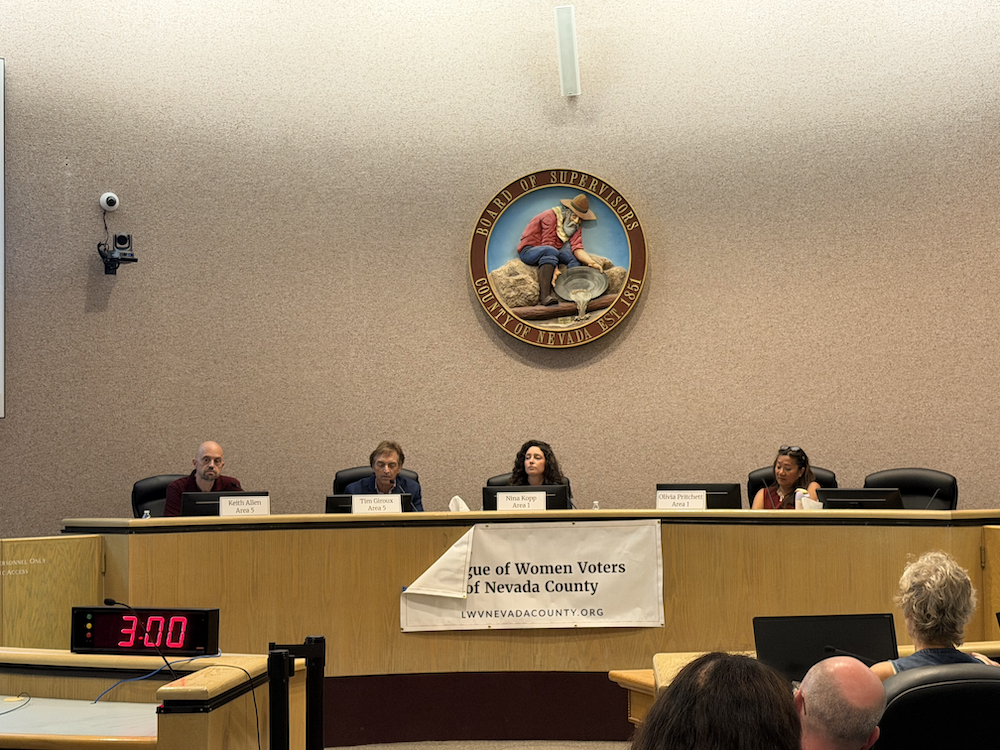
Left to right: Keith Allen, Tim Giroux, Nina Kopp, Olivia Pritchett
At Tuesday's candidate forum, all four candidates for the Nevada Joint Union High School District board wanted students to feel safe, learn core subjects and leave high school with a path forward.
The League of Women Voters of Nevada County hosted the September 22 forum at the Rood Center in Nevada City. Nina Kopp is challenging incumbent Olivia Pritchett for Trustee Area 1. In Trustee Area 5, Tim Giroux faces Keith Allen. The candidates answered the same questions on academics, technology, safety, finances, facilities and staff. The League does not endorse candidates.
Tim Giroux introduced himself as having spent 40 years in professional roles, 17 years as a dentist, and 25 years as a business broker managing complex, multi-million dollar company transitions. He studied accounting and finance in college, which informed his career, and he knows how to manage large budgets and look at the fine print. He added that he is endorsed by outgoing board trustee Ken Johnson, who has 38 years of teaching experience. One of Giroux’s stated priorities was high academic standards and that no student should be bullied or made to feel “insecure in their own skin.”
Keith Allen introduced himself next, saying that he has spent most of his life in this community, having graduated from Bear River. He enrolled in the Army and “served in a combat zone in Iraq,” and “also worked as a long-term substitute teacher in our district.” Allen explained that he was running because he attended a board meeting “and saw the majority of the board ignore the pleas of hundreds of parents and students regarding the safety of their schools.” He repeated, “it’s very important that every student feels that they belong in school and that it’s not a hostile environment for them.” Another priority for Allen was that the joint powers agreement be expanded.
Nina Kopp spoke next, sharing that her three children are sixth-generation Nevada City locals and that she works as an operations and events manager. She explained that she is comfortable working with budgets and timelines, and believes listening is the most important quality for a school board trustee. She said her three priorities are educational excellence, reducing screen time and getting back to the basics to learn more deeply, and making sure “every student, 100% of the time, is leaving high school feeling like they can do something in life,” including earning “certificates in a trade or having apprenticeships or job offers.”
Olivia Pritchett introduced herself last. She touted her four years of service as an incumbent on the board. She said she is a product of public education as well as her three children. She said she is a small business owner and a longtime community volunteer. She said she believes that a trustee’s job is “to do the homework, ask good questions, listen to students, families, staff, and the community, and make thoughtful decisions.” She wanted to strengthen the student trustee participation so that the student voice is strengthened. She said, “I believe we’ve made meaningful progress over the last four years, and there’s more work to do.”
School safety
The candidates differed on how they defined safety as an issue in the district:
Allen defined the district’s culture as causing students to not feel safe, and believed that listening to students would help to create more safety. He also talked about reviewing wildfire plans and ensuring parents know what to do.
Giroux said discipline problems are leading to an unsafe environment at school. He said that he believes clear, progressive consequences would be best.
Pritchett said that students don’t feel safe until they “know that they belong.” She said the solution is to educate the community about upstanders and bystanders. She explained that there are complaints about cases where victims do not get closure or know if a case has been resolved.
Kopp said early reporting and prompt threat assessment were key, including involving specialists or law enforcement where needed. She asserted that reports should be investigated promptly, affected students should be supported adequately, and every student should feel included.
On bullying and violence, the candidates agreed that students must be able to learn without fear.
Kopp emphasized early reporting, prompt assessment of threats, investigation and continued support for students involved.
Pritchett said policies need consistent enforcement and acknowledged that some affected students have not been told when a case has reached a resolution.
Giroux, citing conversations with principals, likewise called for closing that communication gap while respecting privacy, and for clear consequences when students harm others. He added, “I don’t want to make victim classes of any of the students and isolate them into different groups. I do want them to all feel part of one big family, that they’re all brothers and sisters, and they’re all in this together, becoming productive members of society.”
Allen stressed counseling, early intervention and attention to students whose repeated experiences of lesser aggression may be overlooked. “Making sure that happens is about making sure that we have adequate counseling services in place and that we have teachers trained to identify those situations and make sure they’re addressed.”
Agreement on phones and differences over AI
Every candidate favored tighter limits on personal phones, though the proposed rules differed. Kopp was the strongest about favoring in-person interaction during learning time rather than relying on screens to teach. She cited distraction, online bullying, and students' mental health. Pritchett proposed checking phones in at the beginning of the day and returning them at dismissal, with consistent enforcement across classrooms. Giroux said that as he interviewed principals, the consensus was in favor of keeping phones away throughout the day; he wanted to hear from teachers and principals before settling the details. Allen supported collecting phones during each class individually and setting consequences for when students try to evade the rule.
The candidates were further apart on AI. Pritchett said AI should not dominate instruction but students need to learn responsible use, with teacher training and guardrails. Kopp favored removing it from core education time, while leaving room for a specialized technology class. Students should first learn to read deeply, research and reason for themselves, she argued. Allen said the question is when students are ready for the technology; he argued that it is introduced too early and disrupts their development. Giroux likewise favored teaching foundational skills before introducing AI use.
Allen explicitly agreed with Kopp about reducing screens. Giroux also supported Kopp’s emphasis on books, writing and direct interaction. Pritchett shared the others' concern about phones but distinguished them from technology used deliberately for instruction.
What comes after graduation
Kopp said the district should raise math proficiency, and shared specific district statistics on the high percentage of children in the district who “are leaving high school not feeling prepared for college or a career.” She wants to set measurable targets and give every graduate a concrete next step. She advocated books and deep learning over routine screen use and singled out construction trades as a career opportunity. In her closing statement, she condensed her priorities into less screen time, higher academic standards and a plan for every student.
Pritchett pointed to teacher collaboration, classroom observation and scheduled flex time that can provide students extra help. She said the board should keep improving achievement and attendance while supporting routes to universities, community colleges, the trades, the military and employment. She focused on professional learning communities (PLC) for teachers, saying that teachers should spend more of their time collaborating with each other, identifying issues, and problem solving classroom concerns. “I feel like continued PLCs where the teachers can learn from each other and work with each other to help identify the students and find those students and work with them to achieve their goals academically,” she said.
Giroux said schools should study places that have improved reading and other results, then adapt useful practices to the different needs of local campuses. He called for closer coordination with earlier grades so students do not arrive at high school far behind in math or reading. He also proposed developing mentorship and scholarship connections for students pursuing technical education and other paths.
Allen argued that students struggling after the pandemic need individual attention and human connection, including counseling and staff trained to recognize when a student needs help. He urged more work with physical books, paper and research skills. He also supported expanded trades education and said graduates need practical skills for a difficult job market.
Several candidates cited figures or research about achievement and screen-based learning. Their proposed responses, rather than any single statistic, showed how each would approach those issues as a trustee.
Facilities and finances
The moderator asked how the board should prioritize facilities, deferred maintenance, safety upgrades and taxpayer accountability under Measure B.
Giroux called for reviewing facilities spending alongside other district priorities. “We need to look at the entire picture again and try to see if we can do it in the most efficient way possible because our priorities are with the kids and the teachers.”
Kopp described Measure B, the year it was passed, and its value. She described the progress of projects funded by Measure B, explaining that work had already been allocated or completed, and explained that she would examine any additional line items and stand up and ask questions if something seemed out of place.
Pritchett described a “fascinating book” that is “spiral bound” that tells trustees which projects they should consider important. She did not name a particular project to fund next.
Allen said the books should be transparent and expenditures examined in detail. He said he was impressed by how the district pays back its bonds on a schedule. “When it comes to facilities, these are the things that our kids are using every single day.”
On broader finances, Pritchett said the board had confronted a structural deficit and strengthened reserves. Kopp emphasized campus climate and redirecting resources toward academic and trades opportunities. Giroux pointed to his experience evaluating complex financial transactions and said a trustee must consult widely while making difficult choices. Allen proposed a stakeholder advisory group to work through budget concerns before the proposal reaches the board.
All four supported retaining strong teachers and classified employees. Kopp called for open communication and competitive compensation. Pritchett emphasized benefits and pay sufficient for staff to live locally. Giroux said pay and workplace culture both matter; he said he learned that the teachers are not happy with the superintendent. Allen pressed for stronger raises, saying staff feel stretched thin.
The forum also addressed student political and advocacy groups. Kopp defended student expression and the presentation of multiple viewpoints in class, to support “allowing our students to use their own critical thinking skills.” Pritchett disagreed, saying students should be protected against potential hate or potential unsafe feelings. Giroux said students should be able to weigh competing views and be taught by teachers who present various perspectives so well that a student cannot tell what side they’re on. Allen cautioned against singling out any group and urged compliance with education law.
Voters in Areas 1 and 5 will choose between candidates who often identified the same problems but offered different limits, priorities and methods for addressing them. Tuesday's discussion made one question especially concrete: how can schools teach students to use new technology without letting it do their thinking for them?